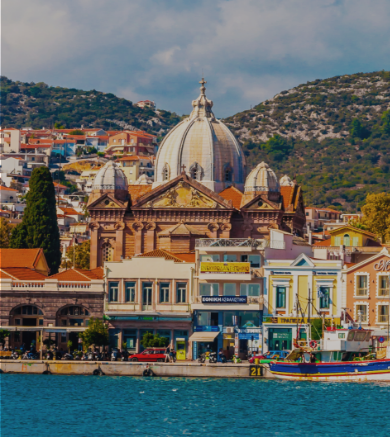
Mytilene, Lesvos: More Than Just a Stopover
Mytilene is the capital of Lesvos, and most travelers treat it like a ferry terminal. That's a real waste. The city holds one of the Mediterranean's largest medieval castles, the birthplace of Sappho, a world-class Archaeological Museum, a living Ottoman quarter, and some of the best ouzo you'll drink in Greece. Give it at least half a day. You won't regret it.
Why Mytilene Deserves More Than an Hour
Most visitors to Lesvos land in Mytilene, collect their luggage, and head straight for the villages. Molyvos, Petra, Sigri — the pull of the north and west is strong. Mytilene gets written off as "just a stopover." That's a mistake.
Mytilene has been continuously inhabited for over 3,000 years. Greeks, Romans, Byzantines, Genoese, and Ottomans all left something behind. The result is a city that layers its history visibly — a neoclassical mansion next to a minaret, a Roman theatre below an apartment block, a harbor lined with kafeneions that have barely changed in a century.
It's not a polished tourist destination. It's a real Greek city, and that's exactly what makes it worth your time.
The Castle of Mytilene (And the View That Pays for the Climb)
What is the Castle of Mytilene? The Castle of Mytilene is one of the largest medieval fortresses in the eastern Mediterranean. Built originally in the Byzantine period and expanded by the Genoese in the 14th century, it sits on a promontory that separates the island's two harbors. You can walk the ramparts, explore the remains of a Byzantine chapel inside the walls, and on a clear day, see the Turkish coastline across the water.
The climb is worth it for the view alone. The fortress covers a huge area, so give yourself at least 45 minutes to explore properly. Entry costs €5. You can find full details and visiting information on the official site for the Medieval Castle of Mytilene. Prefer morning or afternoon visits — the light is better and the site is quieter.
Sappho Square and the Old Harbor
This is where the city breathes. Sappho Square sits at the edge of the old harbor, anchored by a statue of Lesvos's most famous daughter. Sappho, born on this island around 630 BC, is widely considered one of the greatest lyric poets of antiquity. The ancient sources on her life are fragmentary, but her connection to Lesvos is uncontested — and the islanders are proud of it.
The old Town Hall beside the square was built in 1900 and still holds its original facade. The waterfront promenade running south from here is fully pedestrian, lined with kafeneions, ouzeries, and the kind of old men playing backgammon that remind you Greece still exists outside Instagram.
Sit down. Order a coffee. Watch the ferries come in. This is free, and it's one of the best hours you can spend in Lesvos.
The Archaeological Museum: Better Than You Expect
What's inside the Mytilene Archaeological Museum? The Archaeological Museum of Mytilene holds a permanent collection that includes Hellenistic and Roman floor mosaics, wall frescos from ancient villas, sculpture from the 3rd century BC through the Byzantine period, and carved tombstones that give an unusual window into everyday ancient life. The mosaic collection in particular is exceptional and rarely gets the attention it deserves.
The museum is centrally located, climate-controlled, and usually quiet. Admission is €10. It won't take more than 90 minutes, but those 90 minutes will reframe everything you see in the rest of Lesvos.
Don't skip it because you think you've "seen enough museums." This one earns its time.
Ermou Street and the Ottoman Quarter
Ermou Street is Mytilene's main commercial artery, and it's worth a slow walk for the architecture alone. Neoclassical merchant houses from the late 19th century line the upper stretch. Further in, the buildings shift — you're into what was the Ottoman quarter, and the city's Islamic history becomes visible.
Look for the old covered bazaar remnants, the remains of a hammam, small Orthodox churches tucked between taller buildings, and the occasional minaret. The Yeni Mosque still stands near the harbor, now used as an exhibition space.
This neighborhood rewards getting lost. Don't rush. The streets are narrow and mostly flat, and locals are used to visitors wandering around with no particular destination in mind.
Ouzo, Sardines, and the Mytilene Table
What food is Mytilene known for? Lesvos is the birthplace of ouzo, and Mytilene is where you drink it at its source. The island has more than 15 ouzo producers, and local ouzeries serve it the proper way: cold, with a small carafe of water and a plate of mezedes alongside.
Expect sardines, smoked mackerel, local cheeses, olives, and whatever was good at the market that morning. Lesvos ouzo is recognised as a product of protected designation of origin — meaning no one else can legally call it Lesvos ouzo.
Lesvos also produces some of Greece's finest extra virgin olive oil — it makes a good gift if you're heading home with space in a bag.
The Ancient Theatre of Mytilene
This one tends to fly under the radar, but it shouldn't. The Ancient Theatre of Mytilene was built during the Hellenistic period and is one of the largest of its era. Ancient sources suggest it so impressed the Roman general Pompey that he used it as a model for the first permanent theatre built in Rome.
The site is partially excavated and sits above the city with clear views toward the sea. It's documented in detail by the Greek Ministry of Culture and accessible on foot from the city center. Not every site is fully restored, which actually makes it feel more honest than many over-touristed ancient theatres elsewhere in Greece.
The Teriade Museum: Picasso and Chagall on a Greek Island
This one surprises people every time. Stratis Eleftheriades was born in Lesvos in 1897 and left for Paris as a young man. There he became Tériade — one of the most influential art publishers and critics of the 20th century. He worked closely with Picasso, Matisse, Chagall, Miró, and Le Corbusier, commissioning original lithographs and illustrations for his legendary art magazine VERVE and a series of artist books known as the Grands Livres.
When he died, he left it all to the island that raised him. The result is a museum in the Varia suburb, 4km south of Mytilene's center, that holds original works by some of the greatest names in modern art. All 38 issues of VERVE magazine (1937 to 1960) are on display, alongside lithographs, engravings, and illustrated books featuring Chagall, Picasso, Matisse, and others.
It's a small museum. But the quality of what's inside is genuinely unexpected for a village just outside a mid-sized Greek city. Most visitors don't know it exists until someone tells them. Now you know.
How to Get to Mytilene from Northern Lesvos
Mytilene is about 60km from Molyvos — roughly 1 hour and 20 minutes by road through the center of the island. The route is scenic and the road quality is good. If you're driving, note that parking in central Mytilene is tight. The waterfront parking fills fast in summer. Budget extra time.
A better option: let someone else drive. We offer private transfers and full-day tours from Molyvos to Mytilene, with stops you'd never find on your own and none of the stress of navigating an unfamiliar city. You arrive, explore, eat well, and get home — without spending half the day squinting at road signs. Book a transfer to Mytilene.
When to Go
Mytilene is worth visiting in every season. Spring and autumn bring softer light and quieter streets. Summer is lively, with the port buzzing and the ouzeries full. Winter is the city at its most local — fewer tourists, excellent food, and the castle practically to yourself.
Mytilene's port is also the main ferry hub for Lesvos, with regular connections to Piraeus, Chios, and Thessaloniki. If you're arriving by ferry from mainland Greece or another island, you're already here. Walk out of the port, turn left, and start exploring.