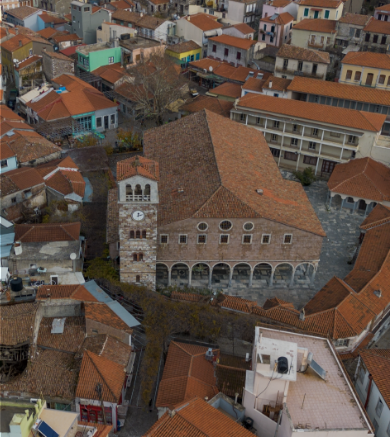
Agiassos, Lesvos: The Village That Refused to Change
Agiassos is a medieval mountain village on Lesvos that has barely changed in centuries. It sits at 475 metres on the slopes of Mount Olympos, and it's home to a revered 9th-century monastery, a covered bazaar still used by locals, and the kind of kafeneion culture you thought only existed in old photographs. If you visit one mountain village on Lesvos, make it this one.
What Makes Agiassos Different from Every Other Greek Village
The short answer: Agiassos still has a working life. It hasn't been hollowed out and rebuilt for tourists, and that's exactly why it's worth your time.
Most Greek villages have lost their everyday rhythm to souvenir shops and staged photo spots. Agiassos hasn't. Local families run the kafeneions. Craftspeople still work in the covered market. The stone-paved lanes were built for donkeys, not cars, and that's still obvious the moment you step out of the car.
The village sits high on the eastern slopes of Mount Olympos, Lesvos' highest peak at 968 metres, at an altitude of 475 metres. The air is noticeably cooler than the coast even in August. Chestnut and oak forests push right up to the village edges. The architecture blends Byzantine, Ottoman, and Aegean stone, with red-tiled roofs and wooden balconies called sahnisinia lining the upper lanes.
This is not a museum village. People live here. That's the difference.
The Monastery of the Panagia Agiasiotissa
The short answer: The Church of the Panagia Agiasiotissa is the spiritual and geographic heart of Agiassos. It holds a miracle-working icon of the Virgin Mary with the Infant Jesus, brought to the island in 803 AD by Agathon the Ephesian from Jerusalem. The current church was built in 1170 at the centre of the village.
The complex includes a small museum with ecclesiastical artefacts and a library with rare manuscripts. The icon, the Panagia i Vrefokratousa (Madonna and Infant Jesus), draws pilgrims from across Lesbos and beyond year-round.
You don't need to be religious to appreciate a visit. The church courtyard is cool and quiet even when the village lanes are busy. The views from the monastery steps over the chestnut groves below are some of the best in the area.
Things to Do in Agiassos
Agiassos rewards slow travel. There's no single attraction with a ticket booth. The village itself is the experience. Here's how to use your time well.
- Walk the cobblestone lanes. The old neighbourhoods above and below the main square are full of arched doorways, geranium-filled balconies, and cats asleep on warm stone. There's no map you need. Walk uphill, then downhill, and stop wherever looks interesting.
- Visit the monastery. The first stop for most visitors and worth at least thirty minutes to explore the courtyard, museum, and church properly.
- Browse the covered bazaar. The old market street (stoa) runs just below the church. Local producers sell olive oil, thyme honey, sheep's milk cheese, and homemade tsipouro. This is a working food market that locals actually use. Buy something.
- Look for the potteries and woodcarving workshops. Agiassos has a long tradition of local crafts, including pottery and wooden carvings. Several small workshops in the village sell handmade pieces — the real thing, not mass-produced imports.
- Hike toward Mount Olympos. A well-marked trail starts from the village and ascends through chestnut groves alongside a stream, with views over the Bay of Yera below. Even a short section of the trail is worth the effort.
- Sit in a kafeneion. Order a Greek coffee. Don't rush. The square in front of the monastery has the old-fashioned kind: wooden interiors, small tables on the cobblestones, locals of all ages.
- Eat at a village taverna. The food here is honest and not aimed at tourists. Roast lamb, wild greens, local sausage, fresh bread.
- Catch the Feast of the Assumption. If you're on Lesvos on August 15th, Agiassos is where the island's biggest religious celebration happens. Hundreds of pilgrims arrive on foot from all over the island.
Agiassos in Summer: The Cool Escape You Need
The short answer: When the coast is hot and crowded in July and August, Agiassos is where smart travellers go. The village sits 475 metres above sea level. That alone makes a real difference on a hot Lesvos summer day.
While beach towns bake, Agiassos stays comfortable. The chestnut forests above the village hold the cool air and create shade you can actually walk in at midday.
The Feast of the Assumption on August 15th turns the village into the beating heart of the island for one day. Pilgrims arrive on foot, music fills the square, the monastery opens its doors to hundreds of visitors, and the kafeneions stay open through the night. It's one of the most alive days anywhere on Lesbos and worth planning your trip around.
Even outside the feast, summer in Agiassos has its own rhythm. Mornings are quiet and cool for exploring. Afternoons stretch long over coffee and local food. Evenings come alive with locals who have escaped the coast, just like you.
Walking the Old Bazaar and Kafeneion Culture
The short answer: The covered market and the main square kafeneions are where Agiassos shows its real character. Go without a plan. Stay longer than you expected.
The bazaar runs along the lane directly below the monastery church. It's one of the few functioning covered markets left on Lesvos. The stalls sell local food products, handmade goods, and basic supplies. It has the feel of a market that was never designed for visitors and has never been redesigned for them.
The kafeneions on the square are old-fashioned in the best possible way: Greek coffee served in a briki, small glasses of ouzo or tsipouro, backgammon boards available if you want one. Order something, take a seat outside, and watch the village move around you.
Try the local soutzouki (spiced dried sausage) and the sheep's milk cheese, both produced nearby and sold in the market stalls. Pair them together and you've got one of the best simple meals you'll have anywhere on Lesvos.
How to Get to Agiassos from Mytilini or Molyvos
The short answer: Agiassos is 26 km from Mytilini and around 55 km from Molyvos. The roads are scenic but winding, and parking inside the village is very limited.
From Mytilini: The drive takes roughly 35 to 40 minutes. Take the main road west and turn south toward Agiassos. The route is well-signposted.
From Molyvos: Agiassos is around 55 km south, a drive of 65 to 75 minutes through the olive grove landscapes of the island's interior. It's a beautiful route.
Parking: The village centre is pedestrian. You'll park at the edge of the village and walk in. During summer weekends, parking fills up fast. A private transfer solves this: you're dropped at the entrance and picked up wherever and whenever suits you. The easiest way to visit is with a local driver who knows the roads.
Coming from Mytilini or Molyvos? Book a transfer to Agiassos — direct, fixed price, no driving.
When to Visit Agiassos
- Spring (April to June): The best all-round season. The chestnut forests are green, the weather is mild, and the village is calm. Perfect for walking, eating, and exploring without crowds.
- Summer (July to August): Hot on the coast, but Agiassos sits high enough to stay comfortable. The Feast of the Assumption on August 15th draws the whole island and is one of the best days to visit.
- Autumn (September to October): Chestnut harvest season. Local festivals celebrate the harvest, the forest colours turn, and the crowds thin out. One of the quietest and most rewarding times to visit.
Book a Private Tour to Agiassos with GoLocal
Agiassos is an easy day trip and a genuinely different experience from anything on the Lesvos coast. GoLocal will get you there and back from your accommodation, with no fixed schedules and no shared vans. You set the pace.