Molyvos, Lesvos: What Nobody Tells You About the Island's Most Beautiful Village
Molyvos sits at the northern tip of Lesvos, and nothing quite prepares you for the first look. Stone houses climb a hillside, a Byzantine castle stands above, a small fishing harbour sits below. It's been drawing visitors for decades and somehow hasn't lost itself. This is a guide to what's actually worth your time, in a village that rewards the curious.
The First Time You See It
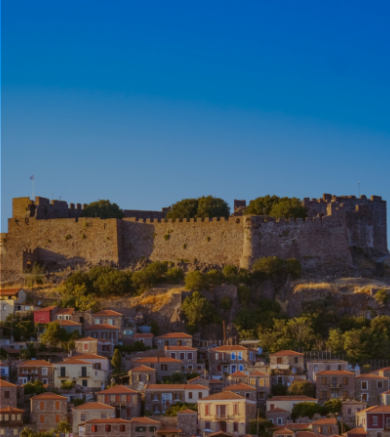
There's a bend in the road coming north from Petra. You round it, and Molyvos is just there. Stone houses stacked on a hillside. Terracotta roofs. The castle at the top. The Aegean below. It's so exactly what you picture when you imagine a Greek village that it almost feels staged. It isn't.
Molyvos has looked roughly like this for centuries. We've taken that road more times than we can count. It still feels like the first time.
The formal name is Mithymna. Ask any local, and they'll call it Molyvos. Both are right. Molyvos is what people mean when they mean this place. At the northern tip of Lesvos, about 62 kilometres from Mytilene, the island's capital. The drive takes you through olive groves, pine forests, and small villages. When you get there, you understand why so many people who come once end up coming back.
The Kastro (Molyvos Castle): What's Up There and Why It's Worth the Climb?
Quick answer: The Kastro of Molyvos is a well-preserved Byzantine fortress, later reinforced by the Genoese and Ottomans. It sits at the top of the village with open views over the Aegean toward Turkey. Entry costs €5. Give it at least an hour.
The Kastro of Molyvos isn't a ruin. It's a real fortress, mostly intact, and you can walk inside it. The original structure dates to Byzantine times, with major additions by the Genoese in the 14th century and the Ottomans after that. Each era left something behind: different stonework, different arches, a different logic to the walls. You can see the history laid on top of itself.
The view from the top is one of the best on Lesvos. On a clear day, which is most days, you can see all the way to the Turkish coast. The sea below is deep blue. The village falls away beneath you in layers.
The castle is lit at night. If you're staying in Molyvos, you'll see it glowing above the rooftops every evening. It never gets old. Get there early in the morning or in the late afternoon. Midday in summer is busy and hot. The walk up from the harbour takes about 20 minutes at a comfortable pace. Worth every step.
The Old Town on Foot
The old town of Molyvos is a designated traditional settlement with protected architecture. Walk without a plan. The streets are cobbled and narrow, the houses are stone, and in April and May, wisteria covers the alleyways. Give yourself a morning.
You can't rush Molyvos. The old town doesn't allow it. The streets are cobbled and narrow, built for donkeys rather than people in a hurry. Stone houses press close on both sides. Bougainvillea spills over walls. In April and May, wisteria blooms across the facades and hangs over the alleyways like a purple ceiling. It smells extraordinary.
There are small shops, a few galleries, the odd cafe tucked into a courtyard. Cats are everywhere, as they are in every good village on Lesbos. Nobody's trying to sell you something from a doorway. Spend a morning just walking with no particular destination. Turn up a staircase you haven't tried. Find a spot where you can sit and look at the rooftops below and the sea beyond.
Molyvos is one of the few officially designated traditional settlements in Greece, meaning development is tightly controlled. What you see today is close to what it has always looked like. The locals fought to keep it that way, and it shows.
The Harbour and the Waterfront
The harbour is the social heart of Molyvos. Fishing boats, waterfront cafes, and some of the best tavernas in the village. Morning or evening are the best times. Eat whatever is freshest that day.
The harbour is small, practical, and exactly right. Fishing boats tie up alongside small pleasure craft. Cafes line the waterfront, tables spilling onto the quayside. In the morning, fishermen bring in the night's catch. By midday, the cafes fill up. In the evening, the whole village seems to drift down here to watch the sun go. Order a coffee and sit for as long as you like. Nobody's moving you on.
If you're eating in Molyvos, the harbour area has the best concentration of tavernas. Go for whatever is freshest that day: squid, octopus, local fish, grilled and kept simple. Add good olive oil, bread, and a small glass of ouzo. Don't overthink it.
The walk from the harbour up through the old town to the castle and back takes you through the best of the village in one continuous loop. Molyvos is small enough to do this in a couple of hours, but good enough that you won't want to stop there.
Eftalou: The Hot Springs Down the Road
Eftalou is 4 kilometres east of Molyvos. There's a small domed bathhouse with thermal spring water at around 43°C, right on the edge of the sea. Most day visitors skip it. They shouldn't.
Four kilometres east of Molyvos, just past a quiet stretch of pebbly beach, you'll find the hot springs at Eftalou. Most day visitors never make it there. That's their loss.
The thermal springs sit in a small traditional bathhouse right at the edge of the sea. The water temperature inside reaches around 43 degrees Celsius. You can soak in the communal pool, or sit where the hot spring water seeps directly into the sea, mixing with the cooler Aegean to whatever temperature you want. It's old, simple, and genuinely good for you. Not a spa. Not a wellness resort. Just hot water, sea air, and a crumbling white dome that has been sitting on that shore for longer than anyone can quite remember.
The beach in front of Eftalou is one of the quieter ones on the north coast. Good for swimming, good for doing nothing. Combined with a morning in Molyvos, it makes for a full and satisfying day.
When Is the Best Time to Visit Molyvos and What Can You Expect?
Quick answer: Molyvos works in every season, and each one offers something different. Spring brings wisteria and wildflowers. Summer is warm, lively, and made for the sea. Autumn turns golden and quiet. Winter is for slow walks and the village to yourself. There's no wrong time.
Spring arrives in Molyvos with wisteria covering the alleyways and wildflowers on the hillsides. April and May are spectacular. The light is soft, the air smells extraordinary, and the sea is warming up. If you want the castle and the old town at their most photogenic, come now.
Summer is peak season for good reason. The sea is perfect, the evenings are long, and the village has a natural energy to it. In August, Molyvos hosts the Molyvos International Music Festival, a week-long classical music event held inside the castle and around the village. A medieval fortress, world-class musicians, warm nights. It works brilliantly.
Autumn changes the light entirely. September and October are golden. The sea stays warm well into October, the pace relaxes, and the olive harvest begins across the island. Everything slows into a rhythm that feels entirely Lesvos.
Winter is for people who want a village to themselves. A few tavernas stay open for locals, the castle is still there, and walking the cobbled streets with nobody else around is its own kind of reward.
However you plan your visit, getting to Molyvos is straightforward. Book your transfer to Molyvos direct from anywhere on the island — fixed price, no driving, no parking stress.
How to See Molivos Properly
Molyvos is 62 kilometres from Mytilene. There's no practical direct bus for a day visit. A rental car gets you there, but the roads in the north are mountain roads, parking in the village itself is limited, and you can't really enjoy a long lunch with ouzo if you're driving back in the dark.
The easiest way to see Molyvos, Eftalou, and other spots along the north coast is on a private tour. You get a local driver who knows the roads, the restaurants, the best moments at each stop, and the kind of context that turns a pretty village into a place you actually understand. No schedule pressure. No group to keep up with.
We run private tours of Molyvos and the north coast of Lesbos, both for guests staying in Molyvos and for visitors based elsewhere on the island. If you want a day that actually delivers, this is how to spend it.
Ready to book? Get in touch with GoLocal Transfers and Tours and we'll put together the right day for you.