Skala Eressos, Lesvos: Sappho, Sunsets and Dark Sand
Skala Eressos sits on the west coast of Lesvos. It has a 3 km beach of dark volcanic sand, a statue of Sappho facing the sea, and one of the best sunsets on the island. The village is relaxed, international, and genuinely welcoming. If you're looking for a full-day trip from the north of Lesvos, this is one of the best you can make.
What Is Skala Eressos?
In short: Skala Eressos is a small beach village on the southwest coast of Lesvos. It sits at the edge of a wide west-facing bay, below the ancient city of Eressos, which is about 4 km inland on a low hill. The village has one main square, a long beach of dark volcanic sand, and tavernas lining the seafront.
The village itself is small. A few hundred people live here year-round. In summer, that number rises considerably, drawn by the beach, the atmosphere, and the sunsets. In September, the village hosts an international women's festival that brings visitors from across Europe and beyond.
It's not a resort. There are no big hotels. What it has is a square full of tables, good food, cold wine, and a beach that faces due west into the Aegean.
The Beach: 3 km of Dark Volcanic Sand
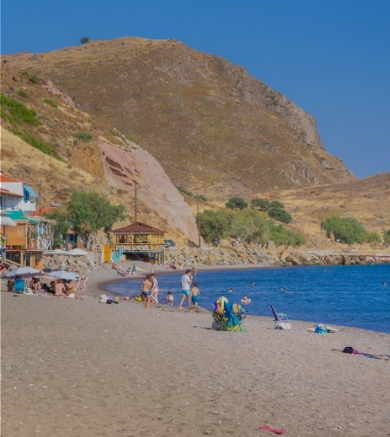
In short: The beach at Skala Eressos is about 3 km long, made of dark grey volcanic sand and fine shingle. The water is calm and sheltered. The bay is wide, the seabed slopes gently, and the swimming is good for most of the season.
The dark sand is one of the first things people notice. It's a deeper grey-black than most Greek beaches, the result of the volcanic geology of western Lesvos. It looks striking in the morning light and holds heat in the afternoon. Bring sandals for the midday walk from your towel to the water. Early morning and evening, it's fine underfoot.
Sunbeds and umbrellas are available along the main stretch near the village. Walk further towards the river mouth at one end or the headland at the other, and it gets quieter. The beach bar nearest the square serves coffee from early morning and keeps going into the night.
The water is clean, the bay is calm, and the approach is gradual. If you're travelling with children or anyone who prefers shallow water and no waves, this beach works well.
What sets it apart from most beaches on Lesvos is the direction it faces. Almost every other good beach on the island looks south or east. Skala Eressos faces west. That single fact makes the evening here different from everywhere else.
Sappho's Birthplace: What That Actually Means
In short: Sappho was born in the ancient city of Eressos, around 630 BC. The ancient city is about 4 km inland from the current beach village. A bronze statue of Sappho stands at the edge of the square, facing the sea. The Archaeological Collection of Eressos, housed in the former school building in Skala Eressos, holds finds from the ancient site.
Sappho was a lyric poet who wrote in the Aeolic Greek dialect. She lived on Lesbos at a time when the island was a centre of culture and literature in the Greek-speaking world. Most of her work survives only in fragments, but what remains was celebrated in antiquity and has been studied and translated ever since. Plato reportedly called her "the tenth Muse."
At Skala Eressos, her presence is visible and felt. The main square is named after her. The bronze statue, steps from the beach, is a focal point for visitors arriving from the shore. It's a good starting point for the village: from the statue you can see the square, the tavernas, and the beach in one glance.
Don't expect a major excavated site. The ancient city of Eressos has not been extensively excavated. What you'll find is a landscape that feels old, a hill with visible walls above the village, and a small but worthwhile museum right in Skala Eressos with mosaic floors, coins, and ceramics recovered from the area.
The Archaeological Collection of Eressos is housed in the former school building in the village, steps from the beach. It opens at 08:30, is closed on Tuesdays, and entry costs €5. The collection takes about 30 minutes to see properly.
The connection between Sappho and this place is real. The ancient city of Eressos is historically accepted as her birthplace. That is reason enough to come, even if the archaeological evidence on the ground is modest.
A Welcoming Village: The International Reputation of Skala Eressos
Skala Eressos has been known for decades as one of Europe's most welcoming destinations for lesbian travellers and women travelling alone or together. This reputation is genuine, longstanding, and shapes the atmosphere of the village throughout the summer season.
The International Eressos Women's Festival was founded in 2000 and takes place each September. It brings women from more than 40 countries to the village for two weeks of music, performance, workshops, and community events centred on the village square. The festival draws a large international crowd and extends the summer season well into autumn.
Outside festival time, the village is simply open. Taverna owners know their international guests well. English is spoken everywhere on the square. The evenings are mixed, relaxed, and unhurried.
If you're planning a trip to Lesvos and want a base that's genuinely welcoming and free of the resort atmosphere that affects some parts of the island, Skala Eressos is a serious option. It does not try to be something it isn't. It is what it is: a small, honest village with a great beach, good food, and a history worth knowing.
The Sunset: Why People Come Back Just for This
The west-facing beach is the key. Skala Eressos gets the full sunset, every clear evening, from April through October. The sun drops into the sea directly in front of the village.
Get a table at one of the square tavernas by 7pm in summer. Order a carafe of local Lesvos wine or a glass of ouzo with ice and water. Watch the light change. This is not advice you need to follow precisely. It's just what works.
The best light comes 20 to 30 minutes before the sun reaches the horizon. The sky turns orange and deep pink, and the dark sand catches the colour in a way that is different from white sand beaches. The whole scene reflects: sky, water, sand.
If you're a photographer, this beach will keep you busy. The dark sand against the evening light gives you contrast you don't get on pale beaches. Shoot from the water's edge looking west for the sun on the horizon. Turn around and shoot east for the warm light falling on the taverna facades and the faces at the tables. You don't need to be a professional to come away with something you'll keep.
If you're making a day trip from the north of Lesvos, time your arrival to allow for a swim, a walk through the village, and an evening on the square. Leave after sunset. The drive back is fine in the dark, and the evening will have been worth it.
Things to Do in Skala Eressos Beyond the Beach
In short: The main activities in Skala Eressos are the beach, the village square, the Sappho statue, the Archaeological Collection of Eressos, and the ancient acropolis hill. Day trips to Sigri and the Petrified Forest are easy to combine.
- The Archaeological Collection of Eressos is right in Skala Eressos, housed in the old school building near the Basilica of St. Andreas. It holds mosaics, coins, pottery, and grave goods from the ancient city. Entry is €5 and the collection takes about 30 minutes. Closed on Tuesdays.
- The ancient acropolis of Eressos is visible from the road above the village. Not a ticketed site — a hill with remnants of old walls and olive trees, with views over the bay. Go in the morning before the heat builds.
- The village square is where most of the social life of Skala Eressos happens. Breakfast, coffee, lunch, evening drinks, dinner: the square handles all of it. Several tavernas specialise in fresh fish brought in by local boats.
- Local wine and ouzo. Ask what is local. Lesvos produces some of the best ouzo in Greece and has small wine producers worth seeking out. The tavernas on the square know what they carry.
- Day trips. The Petrified Forest at Sigri is about 25 km north of Skala Eressos and is one of the most unusual natural sites in Greece, a UNESCO-listed fossil forest tens of millions of years old. If you're already on the west coast, combining both in a single day makes good sense with a private tour.
How to Get to Skala Eressos from Molyvos or Mytilene
In short: Skala Eressos is approximately 55 km from Molyvos, with a driving time of around 1 hour 20 minutes. From Mytilene it's roughly 88 km and about 1 hour 35 minutes. The road is paved but winding. There is no direct public bus connection that makes a day trip practical from the north of the island.
The road from Molyvos heads south through the island's interior before joining the west coast road toward Eressos. The road from Mytilene crosses the central mountain range of Lesvos and passes through Kalloni before continuing west. Both routes are scenic, winding through olive groves and hills with views across the island.
If you're driving yourself, allow extra time for stops. The road through the mountains between Mytilene and the west coast gives you some of the best views on Lesvos.
If you'd rather not drive, a private tour with GoLocal is the most practical option. You set the departure time, make stops along the way, and don't have to worry about finding parking on the square in August.
Need a lift? Book a transfer to Skala Eressos — direct from wherever you're staying on Lesvos.
Book a Private Tour to Skala Eressos with GoLocal
GoLocal runs private tours across Lesvos, including full-day trips to Skala Eressos. We know the road, the best times to arrive, and which tavernas are worth a long lunch.
A full-day tour can combine Skala Eressos with the Petrified Forest at Sigri, the salt pans at Kalloni, or any other stop you want to make on the west side of the island. The route is yours.