Kalloni, Lesvos: More Than a Bird Paradise
Kalloni sits at the heart of Lesvos and it draws bird watchers from across Europe, but that's only part of the story. The salt pans hold over 2,000 flamingos at peak season. The harbour village serves some of the best sardines in the Aegean. The beach is wide, sandy, and genuinely uncrowded. Whether you're chasing birds or just chasing a good meal by the water, Kalloni delivers.
Where Exactly Is Kalloni?
Kalloni is a market town in central Lesvos, sitting roughly halfway between Mytilene and the western tip of the island. The town itself is a few kilometres inland. Most visitors stay in Skala Kalloni, the coastal village on the Gulf of Kalloni, about 3km to the south.
The Gulf of Kalloni has another name that not many visitors know. Scientists and historians call it Aristotle's Lagoon. Aristotle spent two years here, from 345 to 343 BC, studying the marine life of the gulf with local fishermen. His observations formed part of the foundations of Western biology. The lagoon he worked in is the same one you're looking at today.
That central location matters. From Skala Kalloni, you can reach Molyvos in the north in around 35 minutes, the Petrified Forest at Sigri in around an hour, and Plomari in the south in about 75 minutes. If you want to explore all of Lesvos without relocating your base every two days, Kalloni is one of the smartest choices on the island. Explore our private tours of Lesvos.
The Salt Pans: One of Europe's Top Birdwatching Spots
The Kalloni salt pans are an active wetland complex on the Gulf of Kalloni. They're recognised as one of the top birdwatching sites in Europe, particularly during spring migration from April to May. Over 279 species have been recorded across Lesvos, and a large share of those pass through this area. Flamingo numbers can exceed 2,000 individuals at peak times.
The pans cover a large area on both sides of the road leading into Skala Kalloni. They're divided into the East and West Kalloni Saltpans, both of which are documented in detail by Birdingplaces.eu. The Kalloni Environmental Information Center manages several well-positioned birdwatching hides along the access roads, so you don't need to wade through anything to get a good view.
Spring is the headline season. As migrants pour north from sub-Saharan Africa, Lesvos acts as a natural funnel. The salt pans concentrate them. You can find yourself watching hundreds of birds at once. But autumn migration, running from August through October, is also impressive and much less crowded. Even in winter, the flamingos often stay.
- Drive the access roads slowly rather than walking the full perimeter
- Bring binoculars — a 10x42 pair is ideal
- Early morning and evening light are best for photography
- Keep noise low near the hides — birds flush easily at the pans
What Birds Will You Actually See?
Quick answer: Greater Flamingos are the most dramatic sight, often in the hundreds. Beyond them, expect Black and White Storks, Glossy Ibis, Avocets, Collared Pratincoles, European Bee-Eaters, Squacco and Purple Herons, Little Egrets, and various terns. In spring, Red-footed Falcons sometimes perch along telegraph wires in groups of 50 or more, according to Heatherlea Wildlife Holidays.
You don't need to be a serious birder to enjoy this. The flamingos alone are worth stopping for. They wade in the shallows, turning the pans pink on good days. Even children who have no interest in birds tend to go quiet when they see them.
We can get you to the right spots at the right time with a private transfer or custom tour. Browse our private tours.
Beyond the Birds: Skala Kalloni Village
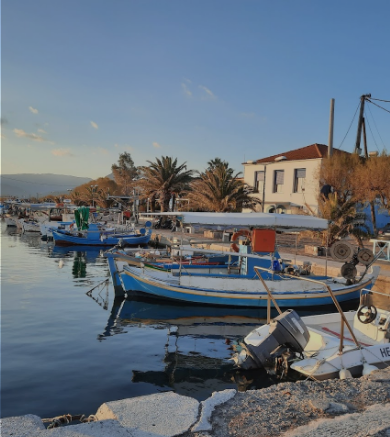
Most birdwatching guides stop at the salt pans. They're missing half the point. Skala Kalloni is a proper working fishing village with a wide sandy beach, a harbour lined with tavernas, and a food culture built around one thing: sardines.
The sardines of the Gulf of Kalloni have a reputation that travels. The plankton-rich, sheltered waters of the enclosed gulf — what Aristotle called his lagoon — produce fish with more fat and flavour than you find elsewhere in Greece. The Kalloni sardine, known locally as papalina, is shorter and thicker than a standard sardine, with whitish flesh and a distinctly sweet flavour. It's currently in the process of receiving PDO (Protected Designation of Origin) status, the same European quality mark carried by Champagne, Parmigiano-Reggiano, and Kalamata olives.
Sit down at any ouzeri along the harbour, order sardines grilled over charcoal, a glass of ouzo, and a plate of local cheese. The salt pans gave you the birds. The harbour gives you this.
Every August, Skala Kalloni holds its Sardine Festival, a celebration of the local catch with grilling, traditional music, and dancing by the water. The festival has drawn attention to the ongoing push for PDO recognition, according to Neos Kosmos. If you're on the island in early August, it's worth planning around.
The beach runs along the seafront and stays quieter than the resort beaches you'll find elsewhere on Lesbos. The water is calm because the gulf is semi-enclosed. It's good for swimming, easy for families, and genuinely relaxed.
Getting to Skala Kalloni from anywhere on Lesvos is easy. Book a transfer to Skala Kalloni — direct, fixed price, no driving.
When is the Best Time to Visit Kalloni?
Quick answer: For birdwatching, visit in April or May. For beach holidays and the sardine festival, July and August work well. For a quieter version of both, September is underrated. Winter is quiet but the flamingos are usually still there.
April to May is the peak for migration. The salt pans are at their most active. Fields around Kalloni explode with red poppies before the summer heat arrives. Temperatures are warm but not punishing. This is when most birding tour groups come to Lesvos, so book accommodation early.
June to August shifts the focus to beach and food. The sardine festival happens in August. The pans are quieter for birds but flamingos remain year-round. Skala Kalloni's beach is at its most active.
September to October brings the second migration wave. Crowds drop significantly. Temperatures ease off. For experienced birders, autumn migration on Lesvos is less predictable but can throw up real surprises, as noted by Nature Watching in Europe.
November to March is quiet. The village slows down. But if you're combining a visit with other parts of Lesvos, winter can be peaceful, cheap, and the flamingos still tend to stay.
Day Trips from Kalloni
Kalloni's central position makes it an excellent base for exploring the whole island. Here are four easy day trips:
Molyvos (Mithymna): The most beautiful village on Lesvos. Castle, cobblestone streets, views across to Turkey. Around 35 minutes north of Kalloni. Read our Molyvos guide.
Sigri and the Petrified Forest: One of the largest petrified forests in the world sits on the western tip of the island. Drive takes under an hour. Read our Petrified Forest guide.
Plomari: The ouzo capital of Greece sits about 75 minutes south. Visit the Varvayannis distillery, walk the old town, and eat at the harbour. Read our Plomari ouzo guide.
Getting to Kalloni from the Airport or Molyvos
Mytilene Airport is the main entry point for Lesvos. From there, Kalloni is about 50km south, a drive of around 60 minutes along a good road. From Molyvos in the north, Kalloni is about 25km south, roughly 30 to 40 minutes depending on the route.
Public transport on Lesvos is limited. Buses run between major towns but schedules don't always match up with early morning birdwatching or late dinner plans. A private transfer takes the guesswork out of it entirely. We run private transfers between Mytilene Airport, Molyvos, Kalloni, and all major destinations on the island. We can also build a full-day tour that takes in the salt pans, Skala Kalloni, and nearby destinations. Book a private transfer.