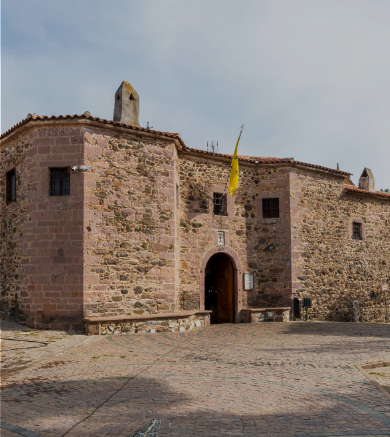
Taxiarchis Monastery, Lesvos: The Icon of Blood and Clay
The Taxiarchis Monastery in Mantamados holds one of the most extraordinary religious objects in all of Greece — a three-dimensional icon of Archangel Michael, said to be moulded from earth soaked in the blood of slaughtered monks. It's one of Lesvos's most visited sites, and it earns every visitor it gets. Here's what to know before you go.
A Monastery Unlike Anything Else in Greece
Most monasteries in Greece follow a familiar pattern. Whitewashed walls, a quiet courtyard, a few candles, a painted icon behind glass. The Taxiarchis Monastery in Mantamados does not follow the same pattern.
What draws people here — pilgrims, travellers, and curious visitors who've heard a fragment of the story — is an icon unlike any other in the Orthodox world. It isn't flat. It isn't painted. And the material it was made from is the reason this monastery leaves an impression that stays with you long after you've driven away.
Mantamados sits in the northern part of Lesvos, about 36 kilometres from Mytilini and roughly 28 kilometres from Molyvos. The village is quiet, traditional, and entirely overshadowed in most guidebooks by the monastery at its edge. That's a shame, because both are worth your time.
The Legend Behind the Icon
In short: The icon of Archangel Michael at Taxiarchis is said to have been created by a young monk who survived a pirate raid, using earth soaked in the blood of his murdered brothers to mould the face of the Archangel.
The story goes back centuries, to a time when pirate raids along the Aegean coast were a regular and deadly threat. According to tradition, a group of pirates attacked the monastery, killing most of the monks inside. One young monk survived. Faced with the bodies of his brothers, he gathered the blood-soaked earth from the ground and used it — mixed with clay — to form a relief icon of Archangel Michael, the protector and commander of the heavenly armies.
The result wasn't a painted image. It is one of the rarest relief icons in the Orthodox world — sculpted rather than painted, and unlike almost anything else you will encounter in a Greek monastery.
Whether you approach this story as history, as legend, or simply as a powerful piece of human testimony, it does something. It changes how you look at what you're about to see.
What You'll See When You Visit
Walk through the monastery gate and you enter a working, living religious site. This isn't a museum. Pilgrims come here throughout the year — and in serious numbers on the Sunday of Myroforoi, two weeks after Easter, when the monastery draws thousands of visitors from across Greece and beyond.
The icon itself is the centre of everything. It sits in the main church, and it is immediately striking. The face is large, textured, and three-dimensional in a way that flat icons simply aren't. Pilgrims approach it directly, touching the surface, leaving offerings. The atmosphere is active, devotional, and — if you're not Orthodox — genuinely moving to witness.
The monastery complex also includes a small courtyard, well-kept gardens, and a shop selling candles and local religious items.
Mantamados Village
Give Mantamados more than five minutes between parking and the monastery door. The village rewards a slow walk.
Mantamados is known across Lesvos for one thing above all: ladotyri, a hard, sharp, PDO-protected cheese aged in olive oil, produced by local families and sold in the village shops. It's one of those things you buy intending to take home and end up eating in the car. Ladotyri Mytilinis has Protected Designation of Origin status, tied to the island's olive-oil tradition.
The village square has a handful of tavernas serving straightforward Greek food. The pace is unhurried. The stone houses, the old kafeneion, the women selling cheese and herbs from doorsteps — this is northern Lesbos without the tourist layer stripped off.
If you're driving up from Mytilini, you'll pass through some of the island's most dramatic landscape on the way: the olive groves of the central plain giving way to the hilly, drier north. It's a good route.
Combine Your Visit: Limonos Monastery near Kalloni
A day trip pairing Taxiarchis with Limonos Monastery near Kalloni makes excellent sense geographically and thematically. Limonos is one of the largest and oldest monasteries on Lesvos, founded in the 16th century, and it holds a significant religious museum with manuscripts, vestments, and ecclesiastical objects spanning several centuries.
Start your morning at Limonos in the Kalloni plain, then drive north through the olive groves to Mantamados in the afternoon. The two monasteries are different in character — Limonos is grand and museum-like, Taxiarchis is intense and alive with pilgrims — and together they give you a full picture of Orthodox monastic life on Lesvos.
The drive between them takes around 35 minutes and passes through some of the island's most quietly beautiful countryside.
How to Get There from Mytilini or Molyvos
The short answer: Mantamados is about 36km from Mytilini (roughly 45 minutes by car) and around 28km from Molyvos (around 45 minutes). There's no reliable public transport. A private tour or rental car is the practical way to get there.
If you're based in Mytilini, the main road north via Mantamados is straightforward and well-signed. If you're staying in Molyvos, Mantamados is a short drive south along the coastal road — easy to fold into a half-day out.
The challenge with public transport on Lesvos is frequency. Buses connect Mytilini to Mantamados, but schedules are limited and won't allow you to combine multiple stops on a single day. A private tour gives you the flexibility to take your time at the monastery, walk the village, and add a stop at Limonos or the Kalloni salt pans without watching a clock.
Ready to visit? Book a private tour with GoLocal and we'll take you there — from Mytilini, Molyvos, or wherever you're based on the island. We know the roads, we know the stops worth making, and we'll make sure you don't miss the cheese.
Arriving on the island the same day? We also run private transfers from Mytilene Airport and the port — Mantamados is an easy stop on the way north to Molyvos.